To help you move to having your rubbish collected every 2 weeks, we will...
Increase the size of rubbish bins
To help with the move to fortnightly rubbish collections, we will increase the size of standard rubbish bins from 80 litre to 120 litres.

Provide options for different size bins
Households can get the right size rubbish bin to suit their needs.
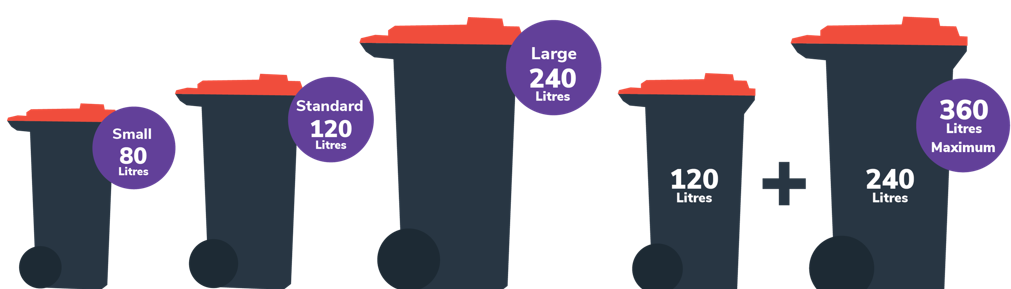
The available bin size options will be:
- Small: 80 litres
- Standard: 120 litres
- Large: 240 litres
- Maximum: 360 litres. This includes 2 rubbish bins: a 240-litre and 120-litre bin.
The standard charge applies to the standard size bin. Smaller bins have a lower waste charge than larger bins.
Provide larger bins at no extra cost for eligible households
Eligible households can get a larger rubbish bin (above the new standard 120-litre bin) at no extra cost. This is called a concession. Concessions are designed to support households that have extra needs.
Your household may be eligible for a concession if:
This is a new concession for the fortnightly rubbish collections.
Who is eligible?
Households with 2 or more children under the age of 4 years in daytime nappies can apply for a large rubbish bin at no extra cost.
Conditions
You may need to provide supporting documentation that shows the children's ages.
This concession has been updated for fortnightly rubbish collections.
Who is eligible?
Households with 4 or more dependents (for example children or elderly relatives) who permanently live at the property can apply for a large rubbish bin at no extra cost.
Conditions
You may need to provide supporting documentation showing the number of people living in your home.
Who is eligible?
Households where someone lives with a medical condition or disability that creates lots of extra waste can apply for a large rubbish bin at no extra cost.
Conditions
You may be need to provide a letter from a medical practitioner or hospital stating that the condition creates extra waste.
Not eligible for a concession?
We understand some households are different. We would consider special requests for exceptional circumstances on a case-by-case basis.
Help you reduce household waste
There are many ways you can begin to reduce waste in your home. This can help create space in your rubbish bin for what needs to be in there.
Putting food scraps into your food and garden organics (FOGO) bin, instead of the rubbish bin, is the number one thing you can do to start reducing your household waste.
We've noticed a lot of food scraps still being put in rubbish bins - about a third of what's in there is food waste. That's like throwing out 5 meals each week!

Top tips to reduce waste at home:
Put food scraps (including meat and bones) in your green food and garden organics (FOGO) bin. They will be turned into compost instead of ending up in landfill.
More people in Merri-bek are using their FOGO bins for food waste than ever before, but food waste still makes up over one third of the average rubbish bin. By using your FOGO bin for food waste instead of your rubbish bin, it can make a big impact.
Learn how to make FOGO work for your household.
By putting the right thing in the right bin, you can make more space in your rubbish bin for general household rubbish.
Almost half of what's in an average rubbish bin in Merri-bek could be composted or recycled simply by putting it in the right bin.
This means you might not need a larger bin.
Update your recycling knowledge - click here to learn how to recycle right
Trial participants told us they became more aware of their waste and recycling, including what they brought into their home. Purchasing products that support the circular economy helped to reduce their household waste.
Examples include:
- buying products in bulk or with less packaging
- minimising take-away and home deliveries
- remembering reusable shopping bags.
Some local supermarkets are accepting soft plastics again for recycling as part of the retailer-led Soft Plastics Taskforce trial.
Soft plastics are items that can be scrunched in your hand like bread bags, food wrappers, and chip packets.
- Give reusable cloth nappies or period products a try. We'll give you a discount of up to $100 on the purchase price of cloth nappies and/or period products. Click here to find out more.
- Using cloth nappies can save space and reduce the smell in your rubbish bin. Whether using them sometimes or all the time, the environmental and cost savings of modern cloth nappies can be significant.
How else can we help you with the change?
Tell us by completing our survey, attending a pop-up or registering for a focus group.